Hidden Sparks: How Unchecked Attic Rodents Threaten Your Home’s Electrical Safety
When mice or rats settle in your attic, they bring more than just noise and contamination. Learn how constant rodent gnawing damages wiring and introduces serious fire hazards.
The Quiet Threat Lurking Overhead
For most homeowners, the attic is an out-of-sight space reserved for seasonal storage, HVAC ductwork, and structural framing. Because foot traffic is rare, it is easy to forget what happens in the dark corners beneath your roof. Unfortunately, this isolation makes the attic an ideal sanctuary for pests. When mice, roof rats, or squirrels slip past your eaves or ridge vents, they do not simply nest quietly; they alter the structural and electrical dynamics of the space.
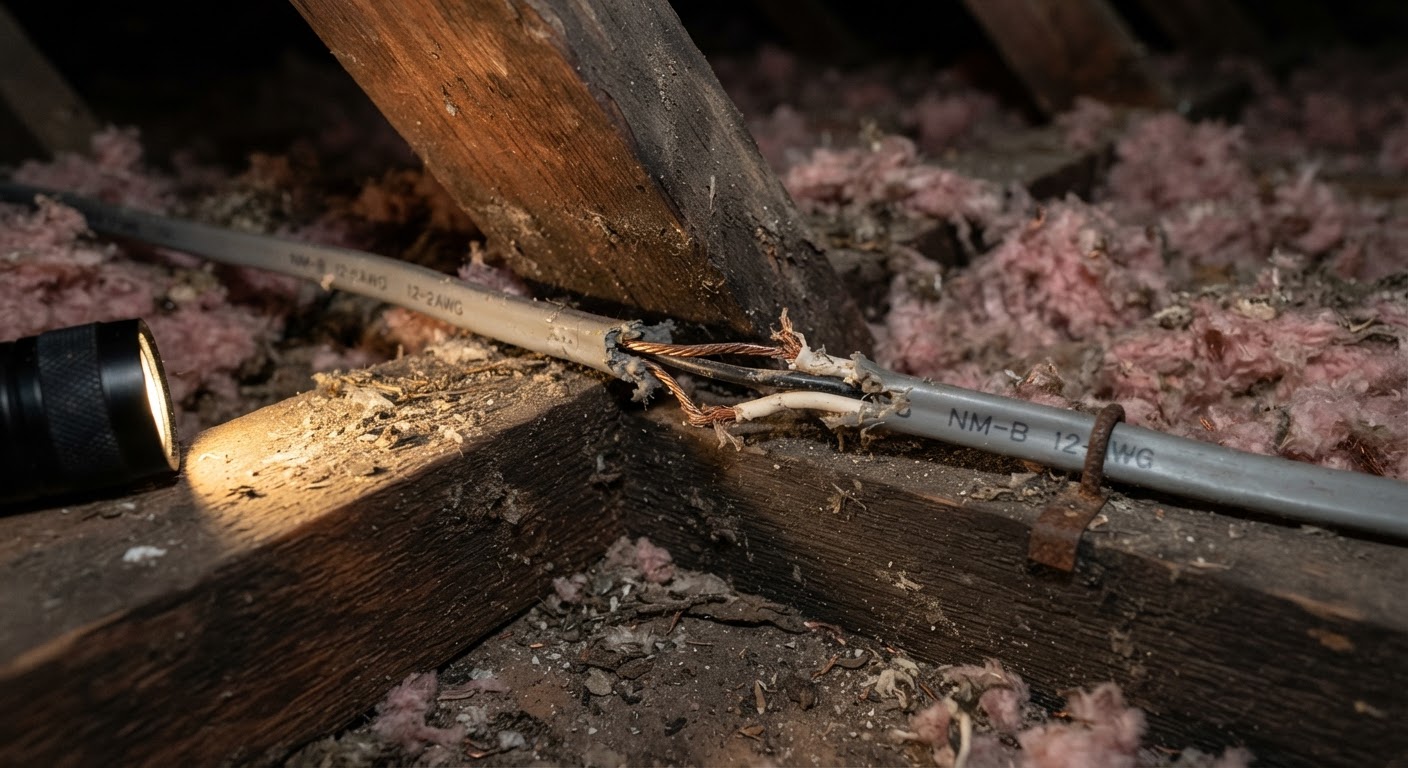
While property owners often worry about the mess, foul odors, and contaminated insulation that rodents leave behind, there is a far more destructive consequence that often goes unnoticed until disaster strikes: damaged electrical wiring. Rodents possess an instinctive, biological need to gnaw, and electrical cables running across attic floor joists are prime targets. Understanding why this happens and recognizing the warning signs is essential to protecting your property and family.
The Biology Behind the Bite: Why Rodents Chew Wires
It is a common misconception that rodents chew on electrical wiring because they are searching for food or attracted to the electricity itself. In reality, their behavior is driven by anatomy. Mice and rats belong to the order Rodentia, a classification defined by a single pair of continuously growing incisors in the upper and lower jaws.
These teeth lack traditional roots and grow steadily throughout the animal’s life. If a rodent does not regularly grind its incisors down against hard surfaces, the teeth will grow too long, curving inward and eventually preventing the animal from eating. To maintain proper dental length and sharpness, rodents gnaw compulsively on whatever materials are within reach, including wood framing, PVC piping, cardboard, and electrical sheathing.
Electrical cables provide an ideal texture for a rodent’s teeth. The pliable thermoplastic or rubber jacket offers enough resistance to file the teeth down without breaking them. Furthermore, cables frequently line the natural travel routes rodents use to navigate the attic. As rodents scurry along top plates, beams, and joists, electrical lines sit directly in their path, serving as convenient chewing posts during routine foraging runs.
How Chewed Wires Escalate into Fire Hazards
Modern residential wiring is engineered to be resilient, but it relies entirely on its protective outer jacket and individual wire insulation to function safely. When a rodent strips away these protective layers, several dangerous conditions develop:
- Exposed Conductors: Once the plastic insulation is gnawed away, the bare copper or aluminum wires are left exposed to the ambient environment.
- Arcing and Short Circuits: If two exposed hot and neutral conductors touch—or if an exposed wire comes into contact with a grounded surface like metal ductwork or nail plates—it can create an electrical arc. Electrical arcing produces intense, concentrated heat capable of reaching thousands of degrees in a fraction of a second.
- The Attic Tinderbox: An attic contains an abundance of readily combustible materials. Dry structural lumber, accumulated dust, cardboard storage boxes, and paper-faced insulation all ignite easily. When an arc occurs next to shredded insulation that rodents have pulled apart for nesting, a localized spark can rapidly transform into an active structural fire within minutes.
- Delayed Breaker Response: While circuit breakers are designed to trip during sudden overloads, a partial short or intermittent arcing caused by frayed, partially severed strands may not always draw enough sustained amperage to trip a standard thermal-magnetic breaker immediately, allowing heat to build quietly within walls or ceilings.
Warning Signs of Damaged Attic Wiring
Because attic wiring is largely hidden beneath blown-in or batt insulation, you might not see the physical damage directly. However, homes often exhibit subtle symptoms when rodent activity begins interfering with electrical systems. Pay close attention to these warning signs:
1. Unexplained Electrical Glitches
If lights in upper-level rooms flicker intermittently, or if a specific outlet stops working without an obvious appliance overload, damaged wiring may be the culprit. A partially severed wire can cause intermittent connectivity or resistance drops that show up as flickering fixtures or weak power delivery.
2. Repeatedly Tripped Circuit Breakers
Circuit breakers that trip frequently without an overloaded power strip or heavy appliance running are a clear signal that something is wrong behind the drywall or overhead. A rodent creating an intermittent short by chewing through hot and ground wires can trigger these sudden interruptions.
3. Subtle Odors of Burning Plastic
Electrical arcing and overheating wire insulation produce a distinct, acrid odor similar to burning plastic, fish, or melting rubber. Because attics share air pathways with living spaces through recessed lights and access hatches, these faint chemical smells can drift into upstairs bedrooms or hallways.
4. Sounds of Scuttling and Chewing
Audible signs of rodent activity often precede electrical symptoms. If you hear light scratching, scampering, or rhythmic gnawing sounds above your ceiling—especially late at night or early in the morning when the house is quiet—rodents are actively moving through your overhead space.
5. Visible Gnaw Marks Near Attic Openings
During a routine trip into the attic, check visible junction boxes, exposed framing, and low-voltage wiring. If you notice chewed edges on cardboard boxes, wood with visible tooth scrapes, or plastic sheathing that appears frayed and scalloped, rodents are actively chewing structural elements in the area.
The Birmingham Environment and Attic Invasions
In Central Alabama, local weather patterns play a major role in how and when rodents enter residential structures. During hot Birmingham summers, attic temperatures can soar, driving pests toward the edges of the roofline and into conditioned wall voids. As cooler autumn and winter weather arrives, attics become prime thermal targets. Heat rising from the living areas creates a temperate pocket beneath the roof deck, drawing roof rats and house mice looking for shelter.
Furthermore, Birmingham’s mature tree canopy—filled with towering oaks and pines—often provides rodents with direct aerial pathways to roofs. Overhanging limbs allow roof rats, skilled climbers that naturally travel elevated surfaces, to leap directly onto shingles, access fascia gaps, squeeze beneath ridge vents, or slip past loosened soffit panels without ever touching the ground.
Why Trapping Alone Does Not Eliminate the Risk
Discovering chewed wires is an urgent situation that requires a two-step approach: addressing the immediate electrical hazard and permanently removing the rodent population. Simply setting a few snap traps in the middle of the attic floor does not resolve the underlying vulnerability.
Rats and mice reproduce at rapid rates, and catching a handful of individuals does nothing to prevent new pests from following the established pheromone trails left along your roofline. Complete resolution requires a thorough strategy:
- Professional Inspection: Locating every point of vulnerability, including gable vents, plumbing penetrations, roof returns, and AC line chases where rodents gain access.
- Targeted Exclusion: Sealing every entry point with rodent-proof materials such as heavy-gauge wire mesh, metal flashing, and specialized sealants that teeth cannot penetrate.
- Population Removal: Strategically trapping the rodents that remain inside the home until all activity ceases.
- Licensed Electrical Assessment: Once pests are removed, any damaged electrical lines should be inspected and properly repaired by a licensed electrician to ensure the home meets current safety standards.
- Sanitation and Nest Removal: Clearing out contaminated nesting material prevents lingering scent trails from attracting future invaders.
Protecting Your Home from Hidden Hazards
Your attic should protect your home from the elements, not serve as a breeding ground for pests that endanger your property's safety. If you have heard movement above your ceiling, noticed unexplained electrical quirks, or simply want to ensure your attic is properly secured against opportunistic pests, professional intervention is the safest and most effective solution.
Contact Alder Crest Pest Control today to schedule a detailed attic and rodent inspection, seal off vulnerable entryways, and keep your Birmingham home secure against hidden hazards.
Need help from Alder Crest Pest Control?
Contact our team to discuss your service needs in Birmingham and surrounding service areas.