Liquid Termite Barriers vs. Bait Systems in Birmingham’s Red Clay: Which Protects Better?
Birmingham’s heavy red clay presents unique challenges for termite protection. Learn how liquid barriers and bait systems perform in dense Alabama soil.
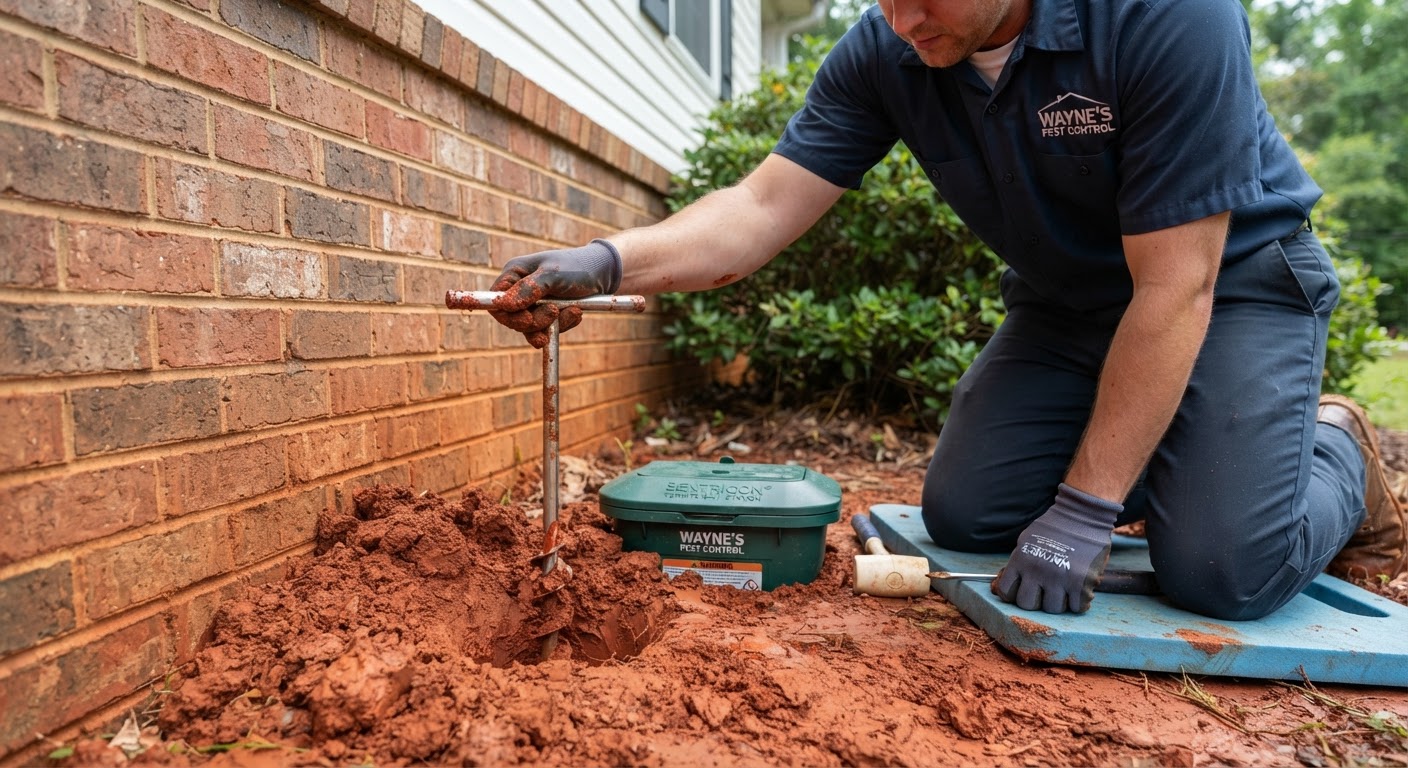
Subterranean termites are a constant reality for property owners across Central Alabama. Our warm, humid climate provides the ideal breeding ground for these wood-destroying insects, making structural protection a necessity rather than an optional safeguard. However, effective termite management involves more than just selecting a proven chemical product; it requires a deep understanding of the ground surrounding your foundation.
Birmingham’s soil profile is dominated by dense, mineral-rich red clay. This heavy soil type behaves very differently from sandy or loamy soils found in coastal or river basin regions. When deciding between a traditional liquid termite barrier and an in-ground baiting system, the physical and chemical characteristics of Birmingham’s red clay play a decisive role in long-term performance.
Understanding the Challenges of Birmingham Red Clay
To evaluate termite treatments fairly, one must first examine the medium into which they are placed. Alabama red clay—primarily composed of weathered Ultisols rich in iron oxides—presents distinct properties that directly influence pest control strategies:
- High Compaction and Density: Red clay particles are microscopic and flat, packing tightly together with minimal pore space. This makes digging, trenching, and soil penetration physically demanding.
- Slow Drainage and Water Retention: Clay absorbs water slowly, but once saturated, it holds onto moisture for extended periods. Conversely, during hot summer dry spells, it shrinks and forms deep fissures.
- Strong Adsorption Capacity: Clay particles possess electrical charges that readily bind to organic compounds and chemicals, which can impact how liquids migrate through the soil column.
These soil mechanics mean that a treatment method that works seamlessly in sandy loam might encounter significant obstacles in a typical yard across Jefferson or Shelby County.
How Liquid Termite Barriers Work
A liquid termite treatment establishes a continuous chemical perimeter around the exterior foundation of a home, as well as along interior crawl space foundation walls and piers. Modern professional applications use non-repellent termiticides. Because termites cannot detect the chemical, they travel through the treated zone, pick up microscopic residues, and transfer the active ingredient back to the colony through social grooming and food sharing.
Liquid Barriers in Birmingham Clay: The Advantages
When applied properly, modern liquid termiticides bind exceptionally well to clay particles. Because clay has high adsorption rates, the chemical adheres tightly to the soil matrix rather than washing away with rainfall. This binding creates a stable, persistent protective zone that can remain active in the soil for years without significant degradation.
Liquid treatments also deliver immediate protection. As soon as the barrier is placed around your perimeter and footings, any subterranean termite attempting to breach the treated soil comes into contact with the product, stopping invasion routes quickly.
The Challenges of Liquid Treatments in Heavy Clay
The primary vulnerability of liquid barriers in Birmingham red clay lies in the installation phase. Because clay is so compact, achieving an uninterrupted, uniform distribution requires meticulous work. If the technician does not trench and rod the soil thoroughly, the liquid may puddle or channel along the path of least resistance rather than dispersing evenly downward and outward.
Furthermore, the shrink-swell cycle of Birmingham clay poses a structural threat to continuous chemical zones. During drought periods, clay dries and contracts, pulling away from concrete footers and stem walls. When winter rains return, the soil expands. Over time, these dramatic shifts can create tiny mechanical fractures or gaps in the chemical barrier, which foraging termites can exploit.
How Termite Bait Systems Work
Termite baiting systems take an entirely different tactical approach. Rather than creating an impenetrable chemical wall, bait systems use the natural foraging behavior of subterranean termites against them. Technicians install bait stations flush with the soil line at regular intervals around the perimeter of the structure.
Inside each station is a cellulose matrix infused with a slow-acting insect growth regulator. Foraging worker termites discover the station, feed on the bait, and carry it back to the colony. The growth regulator prevents termites from molting, gradually collapsing the colony from the inside out, including the queen.
Termite Bait Systems in Birmingham Clay: The Advantages
Bait stations are largely unaffected by the shrink-swell movement that challenges liquid barriers. Because the system relies on active foraging rather than a continuous chemical envelope, a shift in the surrounding dirt does not compromise overall perimeter security.
In addition, Birmingham’s moisture-retentive clay can actually work in favor of bait stations. Subterranean termites require constant moisture to survive and construct their protective mud tubes. Clay holds ground moisture long after rain has stopped, keeping the surrounding soil damp and attracting foraging workers directly to the moisture-retaining bait canisters installed in the ground.
The Challenges of Bait Stations in Heavy Clay
The primary consideration with bait systems in hard clay is station installation and maintenance. Boring into hard-packed, sun-baked clay requires specialized augers. If stations are installed in an area where poor drainage leads to prolonged standing water, the bait matrix inside can degrade or become waterlogged, necessitating more frequent servicing and station cleaning.
Bait systems also require patience. Unlike a liquid barrier that halts entry immediately, bait takes time to eliminate an active colony. If a structure currently suffers from an active interior infestation, relying solely on bait stations around the perimeter may allow structural feeding to continue while the colony slowly consumes the product.
Direct Comparison: Which Method Fits Your Property?
Choosing between a liquid barrier and a bait system often comes down to the architectural layout of your home, the terrain of your lot, and current termite activity.
Foundation Style
Homes built on monolithic concrete slabs often benefit greatly from bait systems because applying an uninterrupted liquid barrier under a vast slab requires drilling through interior floors. Conversely, homes with open, accessible crawl spaces allow technicians to apply liquid treatments directly to foundational piers and curtain walls where clay is sheltered from weather-related soil movement.
Yard Grading and Landscaping
If your home is built on a steep Birmingham slope where heavy rains cause sheet erosion, liquid barriers close to the surface can occasionally wash out before they fully bond with underlying clay layers. In heavily sloped or terraced yards, bait stations anchored securely in the ground often provide more stable long-term monitoring.
Active Infestation vs. Preventive Defense
If live termites are actively feeding on structural framing inside the home, an immediate liquid treatment—either as a targeted spot treatment or complete barrier—is often recommended to neutralize the immediate threat. Bait systems excel as a comprehensive, whole-property prevention strategy that continuously monitors and suppresses nearby colonies before they reach the wood.
Combining Strategies for Maximum Defense
Because subterranean termite pressure in Alabama is among the highest in the country, many pest professionals recommend a dual or hybridized strategy. Targeted liquid applications can secure high-risk entry points, such as plumbing penetrations, expansion joints, and crawl space piers, while an exterior baiting perimeter continuously suppresses the broader subterranean population in the yard.
Every property presents unique factors—from the depth of the topsoil to the grade of the foundation. Evaluating your soil, drainage, and structural construction is the essential first step toward keeping your home protected year-round.
Protect Your Birmingham Home with Alder Crest Pest Control
Navigating termite prevention in Alabama’s challenging red clay requires local expertise and precise application. Alder Crest Pest Control provides thorough property evaluations to determine the safest and most effective termite defense plan for your foundation style and soil conditions. Contact our team today to schedule an inspection and safeguard your home against subterranean termites.
Need help from Alder Crest Pest Control?
Contact our team to discuss your service needs in Birmingham and surrounding service areas.