Beyond the Snap Trap: Why Rodent Exclusion Is the Only Permanent Fix for Your Home
Setting traps may catch the mice currently in your home, but without rodent exclusion, new pests will keep arriving. Discover why sealing structural entry points is the only lasting solution.
When homeowners hear the telltale scampering of tiny feet in the attic or discover droppings beneath the kitchen sink, their first instinct is almost universally the same: visit the hardware store and buy an assortment of traps. Whether traditional wooden snap traps, electronic zappers, or sticky boards, these tools provide an immediate sense of taking action. When a trap trips and catches an intruder, it feels like a definitive victory.
Unfortunately, that victory is usually short-lived. A few weeks or months later, the sounds return, new droppings appear in the pantry, and the cycle begins anew. While traps serve a practical purpose within a comprehensive pest management plan, relying on them as a standalone solution is like bailing water out of a sinking boat without patching the leak. To solve a mouse or rat problem permanently, the focus must shift from simply catching the animals inside to physically barring them from entering in the first place—a process known as rodent exclusion.
The Trapping Dilemma: Managing Symptoms Instead of Causes
Trapping is inherently reactive. It deals exclusively with the rodents that have already bypassed your home's exterior defenses, navigated your wall voids, and established foraging routes across your living spaces. When you catch a rodent in a trap, you remove a single individual, but you have done nothing to address how that animal gained access.
Rodent populations operate within an ecological vacuum. Outdoors, mice and rats face intense competition for food, water, and harborage, alongside pressure from predators like owls, hawks, snakes, and domestic pets. A residential structure represents prime real estate: climate-controlled, dry, secure, and frequently stocked with food scraps or pet kibble. When you eliminate a resident rodent using a trap, you merely vacate prime territory. Unless the physical opening used by that animal is sealed, another rodent from the surrounding environment will inevitably discover the gap and move in.
The Power of Pheromone Trails
Why do new rodents find the exact same entry points into a house? The answer lies in their biology. Rodents possess poor eyesight, relying heavily on tactile feedback from their whiskers and an extraordinary sense of smell. As mice and rats travel, they constantly mark their pathways with urine, fecal pellets, and glandular secretions laden with pheromones.
These chemical trails act as an invisible, persistent road map. Even after an individual rodent is removed, its scent markers remain embedded on brick, wood framing, foundation stone, and insulation. To an outside rodent exploring the perimeter of your house, these pheromones signal safety, shelter, and a viable route indoors. Without physical exclusion, your home remains marked as an open doorway to the local rodent population.
What Does Professional Rodent Exclusion Involve?
Rodent exclusion is the practice of conducting a meticulous structural assessment of a property, identifying every current and potential entry point, and sealing those vulnerabilities with chew-proof, weather-resistant materials. It transforms a porous structure into a fortified envelope.
Achieving true exclusion requires an intimate understanding of rodent capability. An adult mouse requires an opening no larger than a dime (roughly one-quarter of an inch) to squeeze through, while a Norway rat or roof rat can slip through an opening the size of a quarter. If their skull can pass through a gap, the rest of their flexible, collapsible skeleton can follow. Moreover, rodents have continuously growing incisors reinforced with iron-rich enamel, allowing them to gnaw through wood, vinyl, standard caulking, drywall, and soft plastics to enlarge small openings.
Common Structural Vulnerabilities in Central Alabama Homes
In Birmingham and surrounding communities, architectural diversity creates unique structural challenges for rodent prevention. From historic homes with raised crawl spaces to modern slab-on-grade developments, rodents exploit specific architectural weak spots that often go unnoticed by property owners.
Crawl Space Vents and Access Doors
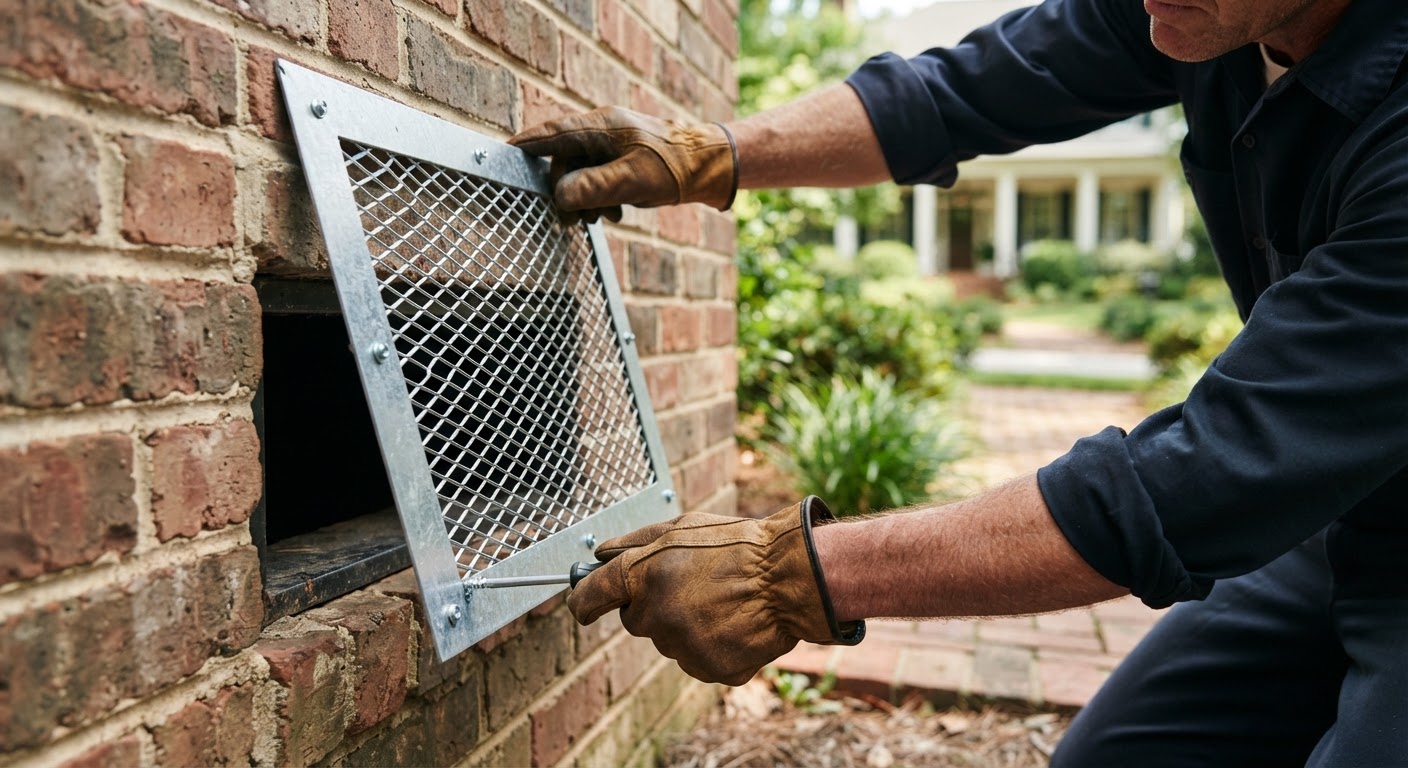
Many homes throughout the region feature vented crawl spaces. Over time, standard wire mesh over crawl space vents rusts, deteriorates, or pulls away from the masonry. Wooden crawl space doors often warp in Southern humidity, leaving gaps along the sill plate or frame. To a mouse or subterranean Norway rat, an unsealed crawl space is an effortless entry point into the substructure, where they can easily access plumbing chases leading up into kitchens and bathrooms.
Weep Holes in Brick Veneer
Brick is one of the most popular exterior cladding materials in the Birmingham area. To allow moisture to escape from behind the brick, builders install weep holes along the foundation line. While necessary for structural drainage, open weep holes are open invitations for mice. Standard expanding foam is insufficient for these openings because rodents will easily chew through it, and solid caulk blocks water drainage. Specialized, breathable metal exclusion inserts are necessary to allow airflow while barring entry.
Soffits, Fascia, and Roof Junctions
Roof rats are prolific across Alabama, and unlike their burrowing cousins, they prefer high-elevation nesting. The lush tree canopy of oak, pine, and sweetgum across local neighborhoods provides natural highways for roof rats to reach gutters and rooflines. Common vulnerabilities include loose soffit panels, rot along fascia boards, gaps where dormers meet roof slopes, and unmeshed ridge vents. Once inside an attic, roof rats can chew electrical wiring, shred fiberglass insulation, and contaminate ceiling drywall.
Utility Penetrations
Air conditioning refrigerant lines, electrical conduits, gas lines, and plumbing pipes must pass through exterior walls to serve the interior. Builders often drill holes significantly larger than the pipes themselves, filling the excess space with cosmetic plastic covers or standard foam. When outdoor temperatures drop in late autumn, warm air escapes through these gaps, creating a thermal beacon that draws rodents straight to the penetration.
Why Quick DIY Fixes Consistently Fail
Homeowners often attempt their own exclusion work using products readily available at home improvement centers, only to find the repairs compromised within weeks. The most common DIY failure is the overuse of expanding spray foam. While polyurethane foam is excellent for draft reduction, rodents view it as soft nesting material. They can chew through cured spray foam in minutes.
Similarly, standard silicone caulk, plastic mesh, and wooden patches provide little resistance against the relentless gnawing of a determined rat. Professional exclusion requires specialized materials designed specifically to withstand rodent teeth and environmental weathering, including:
- Heavy-gauge, galvanized hardware cloth that cannot be chewed through or pushed aside.
- Coarse stainless steel or copper mesh packed tightly into crevices, which causes pain and wear to rodent teeth when they attempt to chew it.
- Custom-bent aluminum or galvanized steel flashing to cap vulnerable corners, fascia transitions, and door sweeps.
- High-density elastomeric sealants infused with pest-deterrent fibers.
The Correct Approach: Integrate, Don't Choose
Understanding the value of exclusion does not mean trapping has no place in pest management. Rather, the two strategies must work together in a synchronized, two-step process.
If you trap rodents without sealing entry points, you face an endless influx of new pests. Conversely, if you seal every entry point on a house without setting interior traps, you trap the existing population inside. Desperate, trapped rodents will chew through interior sheetrock, baseboards, and wiring in an effort to escape or reach food, causing significant structural damage.
The effective methodology begins with sealing the exterior perimeter—closing down the highway. Once the envelope is secure, professional interior trapping is deployed to capture any rodents stranded inside. With the entryways permanently blocked, the interior population is quickly reduced to zero, and because no new animals can enter, the home remains pest-free over the long term.
Protecting Your Home for the Long Haul
Relying solely on traps to handle a rodent issue leaves your home vulnerable to continuous contamination, fire risks from chewed wiring, and ongoing structural wear. By identifying how pests navigate your property's exterior and systematically fortifying those access points, you break the cycle of infestation once and for all.
If you suspect rodents have found a way into your attic, walls, or crawl space, Alder Crest Pest Control provides thorough inspections and durable exclusion services designed to protect Birmingham homes. Contact our team today to schedule an evaluation and secure your home against unwanted intruders.
Need help from Alder Crest Pest Control?
Contact our team to discuss your service needs in Birmingham and surrounding service areas.