Subterranean Termites vs. Carpenter Ants: Identifying Wood-Destroying Pests in Alabama
Learn how to distinguish subterranean termites from carpenter ants in Alabama, including differences in body shape, wood damage patterns, frass, and nesting habits.
Finding signs of wood damage or winged insects inside your home can cause immediate concern. In Alabama, where warm temperatures and high humidity create ideal conditions for pests, two primary culprits are responsible for structural timber issues: subterranean termites and carpenter ants. While both target wood and can cause significant headaches for property owners, they belong to completely different insect orders, behave differently, and require distinct management strategies.
Misidentifying the pest responsible for the damage often leads to delayed or ineffective treatments. Understanding how subterranean termites and carpenter ants differ in appearance, nesting behavior, and signs of activity is the first step toward safeguarding your home.
Physical Differences: Anatomy and Swarmers
Homeowners most frequently encounter these pests during their reproductive swarming phases in the spring and early summer. Because both subterranean termites and carpenter ants produce winged reproductives (known as alates or swarmers), they are easily confused at a glance. However, looking closely at their anatomy reveals clear distinctions.
1. Antennae Shape
One of the quickest ways to differentiate the two insects under magnification is the structure of their antennae:
- Subterranean Termites: Have straight, beaded antennae that resemble a string of tiny round pearls.
- Carpenter Ants: Have "elbowed" antennae that distinctly bend at a sharp angle midway through.
2. Waist Constriction
Looking at the middle section of the body (the thorax and abdomen) also provides an immediate tell:
- Subterranean Termites: Possess a broad, uniform waistline. Their thorax and abdomen blend together without a noticeable narrowing, giving them an elongated, cigar-shaped silhouette.
- Carpenter Ants: Feature a classic narrow, pinched waist (called a petiole) that separates the thorax from the swollen posterior abdomen.
3. Wing Length and Proportion
When dealing with winged swarmers, the wings tell a conclusive story:
- Subterranean Termites: Have four wings of equal size and shape. These wings are typically milky-white, translucent, and significantly longer than the insect's body. Termite wings are also very fragile and are readily shed shortly after a swarm, leaving small piles of discarded wings on windowsills, baseboards, and cobwebs.
- Carpenter Ants: Have two pairs of wings with unequal sizes. The front wings are noticeably larger and longer than the hind wings. Unlike termites, carpenter ants retain their wings longer during the mating flight, and discarded wings are far less common to find in large piles indoors.
Behavioral Differences: Eating Wood vs. Excavating It
The primary biological difference between these two insects lies in why they interact with the wood in your home. This difference directly influences how they damage structural elements and what evidence they leave behind.
Subterranean Termites Consume Cellulose
Subterranean termites are true wood-eaters. They possess specialized microorganisms in their digestive tracts that allow them to digest cellulose, the structural component of wood, paper, and cardboard. Because wood is their primary food source, termites eat away at timber from the inside out, typically following the softer springwood grain. They work silently within structural framing, subfloors, and studs, often leaving only a thin outer veneer of wood or paint intact.
Carpenter Ants Excavate for Shelter
Carpenter ants do not eat wood. They are omnivores that forage outside their nests for proteins, honeydew from aphids, sweets, and dead insects. They hollow out wood solely to create smooth, protected nesting galleries for their queen, eggs, and brood. Because they must dispose of the wood they chew through, they kick it out of tiny openings in the timber, creating piles of debris beneath their nesting sites.
Telltale Signs of Infestation Around Alabama Homes
Because these insects usually hide within wall voids, crawl spaces, and foundation sills, you may notice secondary signs of their presence before you ever spot a living worker. Here is what to look for when inspecting your property.
1. Frass vs. Clean Galleries
The presence or absence of debris is a clear indicator of which pest is present:
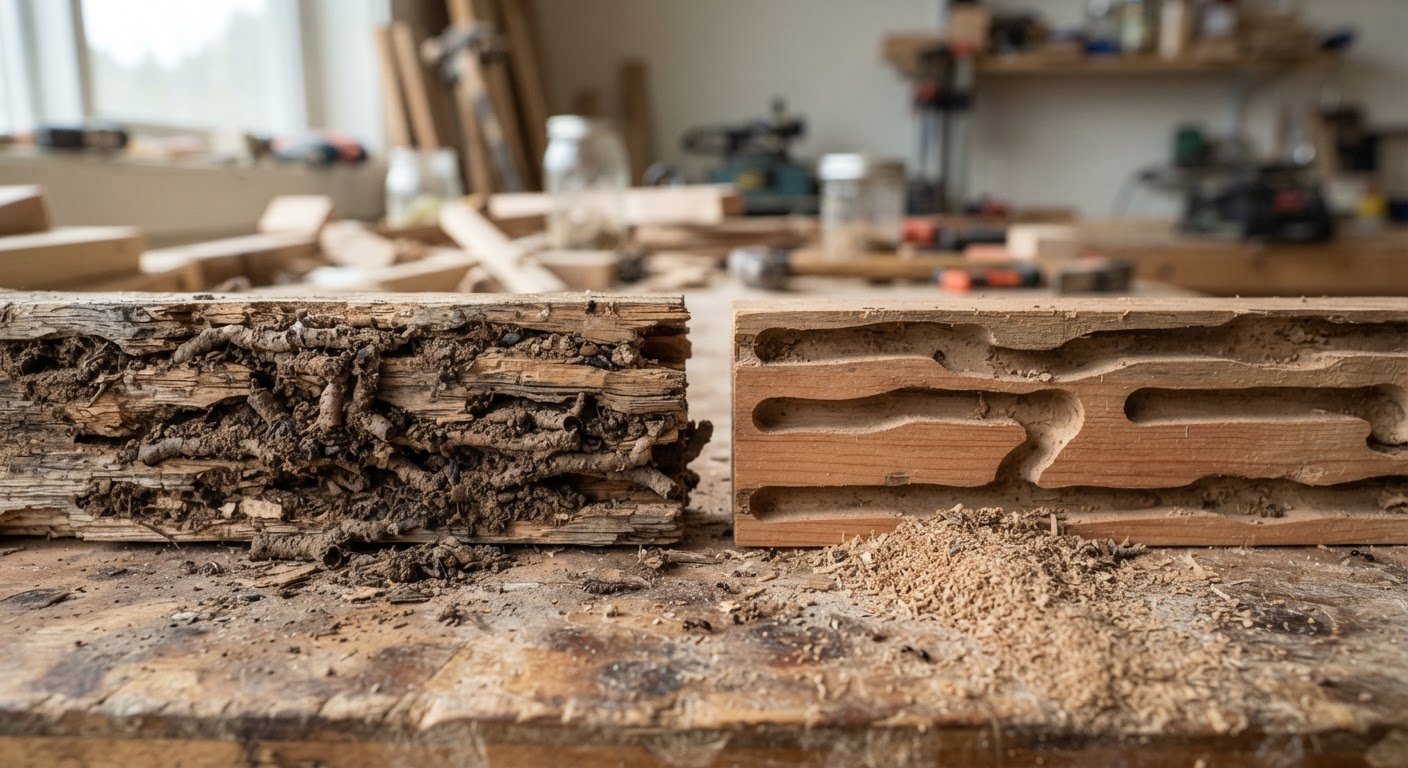
- Carpenter Ant Frass: As carpenter ants carve out their galleries, they push out fine, fibrous wood shavings mixed with fragments of dead nestmates and insect parts. This material, known as frass, resembles coarse sawdust piled up directly beneath baseboards, joists, or wall cracks. Their excavated galleries inside the timber are remarkably clean, smooth, and have a sandpapered appearance.
- Termite Mud and Soil: Subterranean termites leave no sawdust piles. Instead, their galleries are rough, uneven, and packed with dried mud, fecal material, and soil particles. Termites require constant moisture and use this mud to seal off their tunnels from drying air.
2. Mud Shelter Tubes
Subterranean termites must maintain contact with moisture from the earth to survive. When they travel between their subterranean nest in the soil and the wood framing of a home, they construct protective mud tubes across exposed surfaces like concrete foundation walls, crawl space piers, and plumbing pipes. These pencil-thick, earthen tunnels protect them from dry outdoor air and predators. Carpenter ants do not build mud tubes; they simply walk along foundation ledges, pipes, tree branches, or utility wires.
3. Wood Condition and Tap Testing
Gently tapping suspect wood with the handle of a screwdriver can yield clues. Termite-damaged timber often sounds distinctly hollow because the interior has been eaten away, and the wood may easily crush under slight thumb pressure. Carpenter-ant-damaged wood may retain more structural integrity around the nest until the colony grows significantly, though it may also produce a rustling sound if a mature colony is disturbed inside the cavity.
Local Conditions That Favor Both Pests in Central Alabama
Central Alabama provides an ideal environment for both wood-destroying species. Factors that heighten the risk of activity include:
- Abundant Moisture: Frequent rainfall and humid conditions promote wood rot in crawl spaces, fascia boards, and window trim, creating the soft, damp wood preferred by both carpenter ants and subterranean termites.
- Clay Soils: The red clay soil common across the region retains moisture, supporting large subterranean termite colonies that thrive underground.
- Mature Trees: Birmingham's lush tree canopies of oaks and pines mean plenty of decaying limbs, tree stumps, and fallen branches, which serve as natural outdoor reservoirs for carpenter ant colonies before they expand toward residential structures.
Why Proper Identification Dictates the Solution
Attempting to handle either of these pests with over-the-counter surface sprays rarely succeeds and can often complicate the problem. For example, applying a general repellent spray to visible carpenter ants can trigger "budding," causing the colony to fracture into multiple satellite nests within different parts of your home.
For subterranean termites, surface treatments fail completely because the main colony resides deep in the soil, safely out of reach of indoor sprays. Effective termite management requires non-repellent liquid soil treatments or continuous subterranean baiting systems that worker termites unknowingly carry back to eliminate the queen and colony. Carpenter ant management, conversely, focuses on finding the primary nest, eliminating moisture sources, and using specialized baits that foraging workers share throughout the nesting gallery.
Protect Your Home with Alder Crest Pest Control
If you have spotted swarmers, discovered piles of mystery sawdust, or noticed hollow-sounding wood in your home, timely action is essential to prevent costly structural damage. Alder Crest Pest Control provides thorough inspections and targeted treatment plans designed to identify and eliminate wood-destroying organisms. Contact us today to schedule an inspection for your Birmingham home.
Need help from Alder Crest Pest Control?
Contact our team to discuss your service needs in Birmingham and surrounding service areas.