Termite Swarms in Birmingham: When They Appear and What to Do Next
Discover when termite swarms occur in Birmingham, how to distinguish swarmers from flying ants, and the essential steps to take if you find them inside or around your home.
Spring in Central Alabama brings blooming dogwoods, warmer afternoons, and periods of heavy rainfall. Along with the pleasant weather, these environmental conditions trigger an event that every local homeowner dreads: termite swarm season. When winged insects suddenly emerge by the dozens or hundreds around your porch lights or on your living room windowsill, it can be alarming. Understanding why this happens, when it peaks in the Birmingham area, and how to respond can protect your home from significant structural damage.
The Rhythm of Swarm Season in Central Alabama
Termites do not swarm randomly. Swarming is a carefully coordinated reproductive event that requires specific environmental conditions. In Birmingham, subterranean termites rely on a combination of rising temperatures, damp soil, and calm winds to initiate their flight.
Typically, the primary termite swarm season begins in late February and extends through May. The onset often coincides with the first stretch of genuinely warm spring weather following a rain shower. High humidity levels and saturated ground create the ideal environment for these fragile insects to leave their underground colonies without immediately drying out.
Timing by Species: Eastern Subterranean vs. Formosan Termites
Not all termites follow the exact same calendar. In our region, homeowners primarily encounter two types of subterranean termites, each with distinct swarming patterns:
- Eastern Subterranean Termites: This is the most common native species in Alabama. They generally swarm during the daytime, typically from mid-morning to early afternoon, from March through May. They often appear on bright, sunny days immediately following a spring rainstorm.
- Formosan Subterranean Termites: While historically more concentrated along the Gulf Coast, Formosan termites have established footholds further north into Alabama. Formosans swarm later in the season, typically from late spring into early summer (May through July). Unlike their native cousins, Formosans swarm at dusk or during the evening and are intensely attracted to artificial lights, making them a common sight around exterior light fixtures and illuminated windows.
Why Termites Swarm in the First Place
A termite swarm is often mistaken for a sudden infestation that just arrived overnight, but it is actually the byproduct of an already mature, well-established colony. Colonies take three to five years to reach the size and stability required to produce reproductive members, known as alates or swarmers.
When a colony is large enough, the queen produces winged reproductives. Once environmental triggers align, thousands of these winged termites leave the nest simultaneously in a nuptial flight. Their purpose is simple: disperse, find a mate, shed their wings, burrow into moist soil or damp wood, and establish a new colony.
Termites are notoriously poor fliers. They flutter awkwardly and drift on light breezes, rarely traveling more than a few hundred feet from their parent nest unless carried by strong gusts. This limited flight range means that if you see a dense swarm around your foundation, the parent colony is almost certainly nearby.
Flying Ants or Swarming Termites: How to Spot the Difference
Spring is also the time when various species of ants produce winged reproductives. Because winged ants and swarming termites look similar at first glance, homeowners often misidentify the insects they are dealing with. Distinguishing between the two is critical, as the treatment methods and risks are vastly different.
Look closely at the following physical traits:
- Waist Shape: Termites have a thick, uniform body with no defined waistline. Ants have a distinct, pinched waist that separates the thorax from the abdomen.
- Wing Appearance: Termite swarmers have four wings that are completely identical in size, shape, and delicate veined texture. Ant swarmers also have four wings, but the front pair is noticeably larger than the hind pair. Termite wings are also roughly twice the length of the body.
- Antennae: Termite antennae are straight and resemble tiny strings of beads. Ant antennae are distinctly bent or elbowed in the middle.
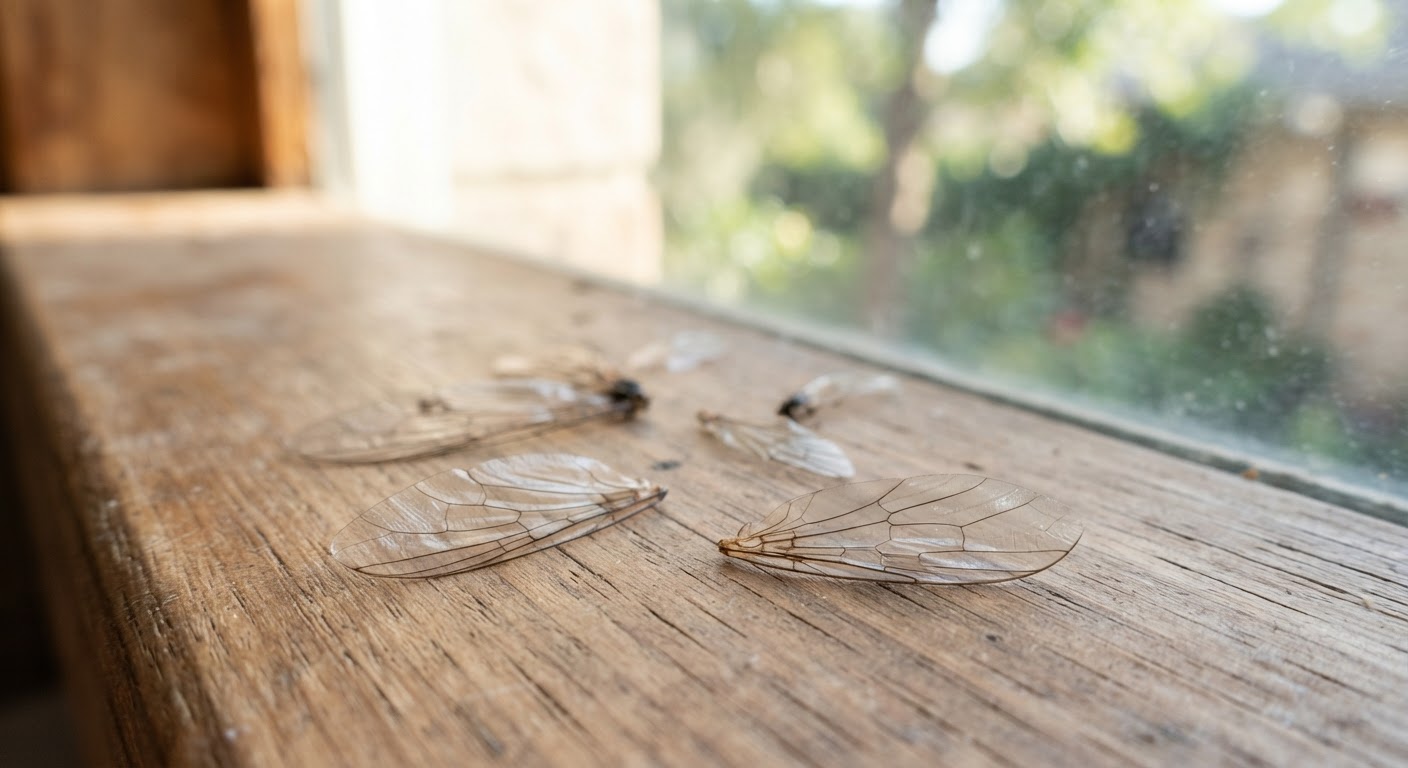
- Discarded Wings: Termites shed their wings quickly after landing. If you find piles of translucent, uniform wings on a windowsill or floor without many insect bodies nearby, you are likely looking at termite evidence. Winged ants do not shed their wings as readily.
Immediate Steps to Take When You Spot Swarmers
Discovering a swarm can cause immediate panic, but taking calculated, practical steps will help you resolve the situation effectively.
What Not to Do: Avoid the Can of Bug Spray
Your first instinct might be to grab a can of aerosol insecticide and spray the swarmers. Resist this urge. Spraying active swarmers does nothing to address the thousands or millions of worker termites chewing on wood inside your walls or under your foundation. Furthermore, heavy chemical sprays can cause termites to seal off active tunnels and forage elsewhere in the structure, complicating professional inspection and treatment.
Collect a Specimen for Identification
Before vacuuming or sweeping up the insects, capture several intact specimens in a clear plastic bag or a small jar with a lid. Having preserved specimens allows a pest control professional to confirm whether you are dealing with Eastern subterranean termites, Formosan termites, or harmless outdoor ants.
Vacuum the Area
Swarmers do not bite, sting, or consume wood. Their only biological goal is reproduction, and without immediate access to damp soil, indoor swarmers dehydrate and die within hours. To clean them up, simply vacuum them from floors, sills, and baseboards. Once finished, empty the vacuum canister or discard the vacuum bag into an exterior trash bin.
Check for Indoor Flight Holes and Mud Tubes
Examine the room where the swarm appeared. Look for small, pinpoint holes in sheetrock, baseboards, or door frames where the insects emerged. You may also see pencil-sized mud tubes running up foundation walls, across floor joists in the crawl space, or along concrete slab perimeters. These shelter tubes are constructed by worker termites to travel between the soil and their food source while maintaining humidity.
Indoor Swarm vs. Outdoor Swarm: Assessing the Severity
The location of the swarm provides important context about the level of threat to your home.
If you find swarmers outdoors: Seeing a swarm emerging from an old tree stump, landscape timber, or a fence post twenty yards from your house does not necessarily mean your home is infested. Subterranean termites are a natural part of the local ecosystem, breaking down dead plant material. However, an outdoor swarm near your exterior foundation is a clear warning that an active colony exists nearby, signaling that your home's perimeter defense needs an evaluation.
If you find swarmers indoors: A swarm emerging inside your living room, kitchen, crawl space, or basement is a clear indication that a colony has established a path directly into your home. Termites cannot chew through intact drywall; they emerge through existing cracks, gaps around plumbing, or small exit holes they create specifically for swarming. An indoor swarm should always be treated as an urgent structural concern.
Protecting Your Birmingham Home Moving Forward
Because Central Alabama’s climate is exceptionally hospitable to subterranean termites, passive observation is rarely enough to protect a home long-term. Even if a swarm dies off and you stop seeing winged insects after a few days, the worker termites remain hidden, continuously consuming cellulose framing, subflooring, and joists.
Professional management requires a comprehensive inspection to pinpoint entry points, identify structural vulnerabilities like soil-to-wood contact or crawl space moisture, and install targeted treatment barriers that eliminate the colony at its source.
If you have spotted winged insects, piles of discarded wings, or suspicious mud tubes around your property, do not wait for visible wood damage to appear. Contact Alder Crest Pest Control today to schedule a thorough termite inspection and protect your Birmingham home from wood-destroying pests.
Need help from Alder Crest Pest Control?
Contact our team to discuss your service needs in Birmingham and surrounding service areas.